If you’re sourcing wholesale human hair, choosing between Vietnamese hair vs Chinese hair can directly affect your product quality and long-term profit. While both countries dominate the global hair extension industry, their raw materials, manufacturing methods, and pricing models differ significantly.
Quick Comparison of the Difference Between Vietnamese Hair vs Chinese Hair
The following are the key differences between Vietnamese hair and Chinese hair to give you more insightful information:
| Criteria | Vietnamese Hair | Chinese Hair |
| Origin | Mostly collected from Vietnamese donors | Often sourced from mixed origins |
| Quality | Known for high quality, especially with raw and virgin hair | Available in a wide range of qualities, from natural human hair to processed or blended options |
| Characteristics | Fine, soft, naturally silky, and straight | Thicker, coarser, and rougher texture |
| Durability | Typically has a long lifespan with proper care | Lifespan depends on the grade; average products may wear out faster |
| Lifespan | 2–5+ years (with proper care) | Averagely 6–12 months, with premium grades lasting a few years |
| Price | Higher, because of raw quality and durability. | Cheaper, due to mass industrial production |
| Stock Availability | Limited ready stock; production often starts after an order is placed | Large quantities of ready stock for fast delivery |
| Best For | Buyers seeking long-lasting, high-quality hair | Buyers needing bulk orders, quick shipping, and consistent stock |
| Market Popularity | Highly favored in high-end markets (Europe and the United States). | More common in budget-friendly markets, especially in Asia. |
Vietnamese Hair vs Chinese Hair: Detailed Differences
Understanding the key differences between them and choosing the best option for your business or personal needs.
The Origins of Vietnamese Hair and Chinese Hair
Vietnamese hair is human hair collected primarily from Vietnamese donors. Vietnamese hair is widely regarded as one of the highest-quality raw materials in the global premium hair industry. The country’s competitive advantage lies in the consistency of its virgin hair quality.
Chinese hair generally refers to hair products manufactured in China, which may include locally sourced hair, imported hair, or blended materials depending on the factory. Chinese hair has historically dominated the global human hair processing industry due to China’s extensive manufacturing capacity rather than its raw material supply.
Many Chinese manufacturers import raw hair from countries such as India, Vietnam, Myanmar, and Cambodia before processing and exporting finished products. However, concerns regarding inconsistent raw material quality and the mixing of hair from multiple origins have affected consumer perceptions in premium market segments.
The Quality of Vietnamese Hair and Chinese Hair
The factor that cannot be ignored in the difference between Chinese and Vietnamese hair is quality. This is what defines the Vietnamese hair brand.
| Vietnamese Hair (typical) | Chinese Hair (typical) | |
| Origin | Mostly from local Vietnamese donors (single-origin) | Often imported from many countries (multi-origin) |
| Characteristics | Natural color, thick strands, minimal chemicals, less shedding | Very shiny, often chemically treated, may tangle/shed more over time |
| Duration | Longer (often 2–5+ years with good care) | Shorter average (often 6–12 months for standard processed hair) |
In short, Vietnamese hair is generally sourced more transparently from local donors, whereas many Chinese factories use mixed-origin hair. Though it is not completely free of tangling and shedding, Vietnamese hair is silkier and less prone to them.
The Durability and Lifespan of Vietnamese and Chinese Hair
When it comes to the durability and lifespan of Vietnamese hair versus Chinese hair, there are some key distinctions to consider.
- Vietnamese hair is known for its long durability and, with proper care, typically lasts 2-5 years. This is because Vietnamese hair is naturally stronger, making it less prone to breakage and damage. Additionally, the cuticles of Vietnamese hair are typically more intact, which helps to prevent tangling and shedding.
- On the other hand, Chinese hair tends to have a shorter lifespan. Average Chinese hair often lasts 6–12 months, while premium grades can last a few years. Chinese hair is typically more delicate than Vietnamese hair; additionally, its cuticles are often more damaged.
Overall, Vietnamese hair tends to be the better choice for durability and lifespan. However, it’s important to carefully consider all factors when selecting hair extensions, as hair quality and longevity can vary greatly.
It’s important to note that the durability and lifespan of both Vietnamese and Chinese hair can be affected by various factors, including how the hair is sourced, processed, and cared for. For example, hair that has been chemically treated or exposed to excessive heat may have a shorter lifespan than hair left in its natural state. Similarly, using harsh shampoos or styling products can damage hair cuticles, leading to tangling and shedding.
Vietnamese vs Chinese Hair Extensions and Products
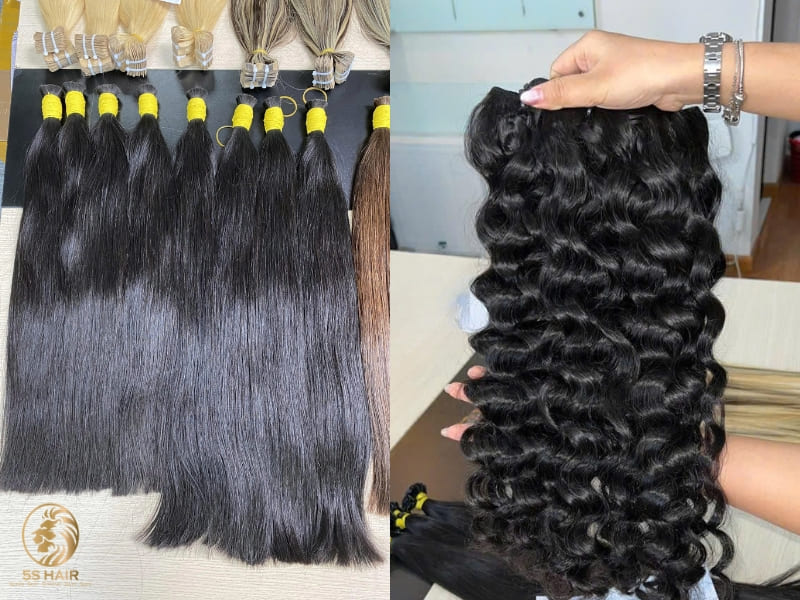
Both Vietnamese and Chinese hair are popular choices when buying hair extensions and products.
- Vietnamese hair is a good choice for hair extensions worn frequently or for extended periods. Vietnamese hair also tends to have a natural shine that can make it look healthier and more vibrant.
- Chinese hair is often more affordable than Vietnamese hair. It can also be a good choice for those who want a more natural look, as Chinese hair is often finer and less shiny than Vietnamese hair. Additionally, Chinese hair can be easier to style and manipulate due to its finer texture.
The Price of Vietnamese Hair and Chinese Hair
Vietnamese hair is usually slightly more expensive than Chinese hair, reflecting its higher quality and longer durability.
- Vietnamese hair: Generally, it offers a good balance of quality and price, ideal for buyers seeking long-lasting, high-quality hair. Prices vary by vendor, grade, length, and texture.
- Chinese hair: Available across a wide price range, from budget to premium. Prices also vary by vendor, grade, length, and texture.
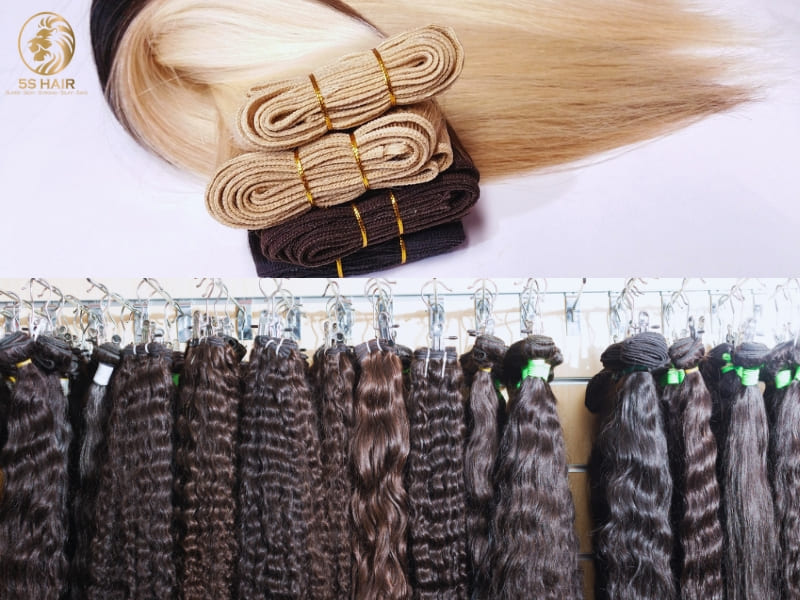
The Availability of Vietnamese Hair and Chinese Hair
This also indirectly affects the quality of Vietnamese hair vs Chinese hair.
Chinese Hair in Stock
Due to the extreme, constant, and strong demand, China’s manufacturers produce a large amount of hair in all types and lengths, available for immediate shipment worldwide.
- Every day, a massive volume of Chinese hair is produced on an industrial scale, supplying wholesale hair merchants and even retail clients worldwide. When clients place orders for hair extensions, Chinese companies can simply ship the extensions currently in stock right away.
- However, Chinese hair comes from many sources, and its quality is not uniform, so leaving it for so long really affects the hair texture.
Vietnamese Hair in Stock
Vietnamese hair factories, aiming to produce high-quality raw hair, typically do not mass-produce and store large quantities of stock as many Chinese factories do, because prolonged storage can reduce softness and moisture.
- Instead, many Vietnamese suppliers prefer to use fresh, recently sourced hair materials for each client order, so that each bundle is more likely to be silky, smooth, and soft.
- In recent years, Vietnamese factories have improved their production capacity and delivery speed, so the gap with China in product lead time has narrowed for typical orders. However, China still leads in very large-scale, fast mass production.
Overall, Vietnamese hair from reputable factories tends to have more consistent texture and durability. Still, quality depends on the specific factory and grade.
Production Scale of Vietnamese Hair and Chinese Hair Suppliers
Industrial-scale Production of Chinese Hair Factories:
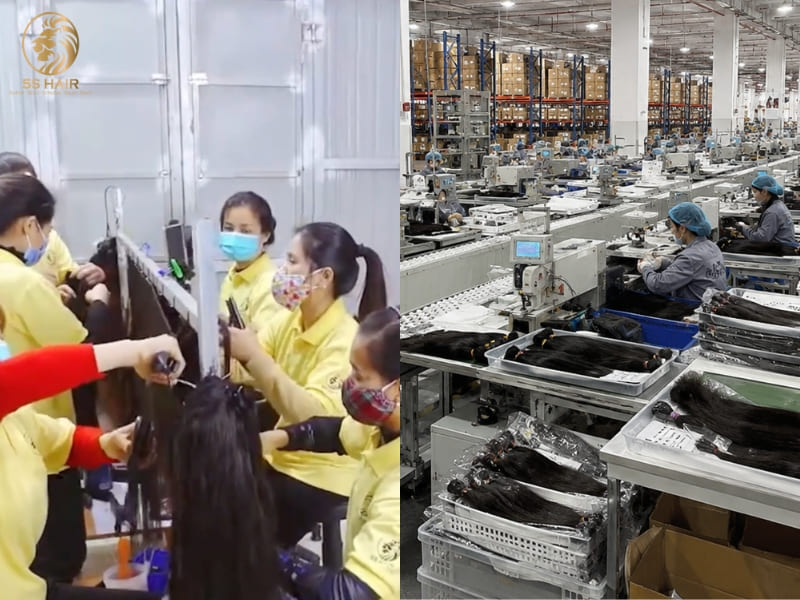
Everyone thinks of China as a powerful country with the world’s largest industrial base. Although hair extensions should be handcrafted for the highest quality, Chinese hair manufacturers use the latest technologies and mass production to produce a large number of hair extensions that are always in stock.
However, due to prolonged storage, volume loss is inevitable.
Medium-scale Production of Vietnamese Hair Factories:
Unlike Chinese hair manufacturers, Vietnamese hair suppliers tend to focus on producing a moderate amount, as this allows them to manage the product more carefully. In Vietnam, there are trading villages that specialize solely in hair production.
Although the output is not as large as Chinese hair, Vietnamese hair is produced according to each order, so it is the freshest and newest. Vietnamese hair texture is typically guaranteed.
Pros and Cons of Vietnamese Hair vs Chinese Hair
Below is an overview of their key strengths and considerations for buying.
Pros and Cons of Vietnamese Hair
Pros:
- Premium Quality: Vietnamese hair is well-regarded for its strength, thickness, and durability. It’s a long-lasting option for extensions.
- Soft and Silky Texture: Its natural smoothness lends extensions a realistic, luxurious look.
- Low Shedding: Compared to other types, Vietnamese hair is generally less prone to tangling when high-quality and well-maintained, extending the lifespan of the extensions.
Cons:
- Limited Supply: Vietnamese hair is harder to source, which often makes it pricier than alternatives.
Pros and Cons of Chinese Hair
Pros:
- Cost-Effective: Chinese hair is generally more affordable, making it attractive for budget-conscious buyers.
- Thick and Resilient: Its strength allows it to endure frequent use and styling.
- Versatile Styling: Easy to style into different looks, offering flexibility for wearers.
Cons:
- Tangles Frequently: It is more prone to knots, demanding extra effort in daily care.
- Higher Shedding: Extensions may not last as long because Chinese hair sheds more easily.
- Susceptible to Damage: Heat styling and chemical products can weaken hair more quickly than in other types.
Read more: Differences Between Indian Hair Vs Vietnamese Hair
Should I Choose Vietnamese Hair or Chinese Hair?
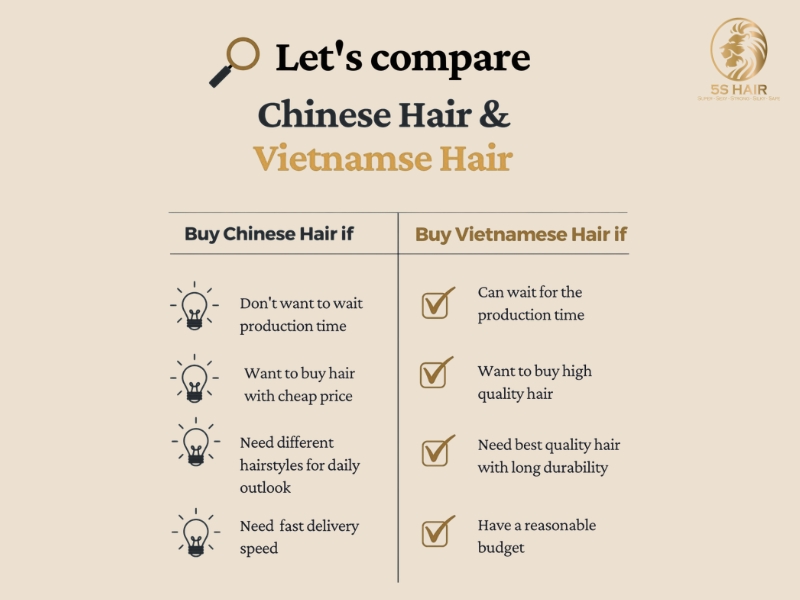
Both Vietnamese and Chinese hair have advantages and drawbacks. After clearly understanding the differences between Chinese and Vietnamese products, you should consider your intended use, your ability to wait for manufacturing time, and your budget to make the best decision.
- If you prioritize speed, extremely large quantities, and low prices, Chinese hair can satisfy those needs. Choose Chinese hair if your priority is competitive pricing, immediate stock availability, or the ability to fulfill large wholesale orders quickly. Its industrial-scale production makes it a practical option for businesses serving budget-conscious markets or requiring fast turnaround. However, be sure to communicate clearly with your supplier about the hair grade and quality before purchasing.
- Choose Vietnamese hair if you value premium quality, durability, and long-term customer satisfaction over the lowest purchase price. It is an excellent choice for premium hair extensions, custom wigs, salon-grade products, and businesses aiming to build a reputation based on quality and repeat customers. It is also a suitable option for entrepreneurs starting a hair business, as high-quality products can help establish customer trust and brand credibility.
- Consider both if your business serves different customer segments. Many successful distributors source Vietnamese hair for premium collections while using Chinese hair for entry-level product lines.
Where Can I Find Reliable Vietnamese Wholesale Hair Factories?
If you want to import hair from Vietnam, take a look at the top wholesale Vietnamese hair factories:
5S Hair – Reliable Vietnamese Hair Factory, at Highly Competitive Pricing
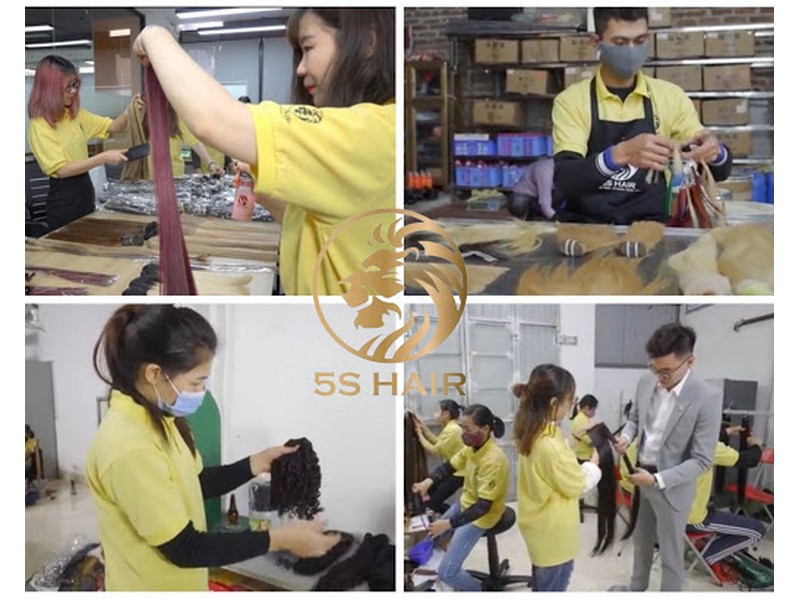
5S Hair manufacturer is one of the most popular Vietnamese hair factories that offers high-quality Vietnamese raw bulk virgin hair, weft hair, closure frontal, wigs, and more to wholesale hair sellers all over the world, such as Brazil, Dubai, Russia, America, and Africa (Nigeria, Ghana, South Africa, etc.)
With their reasonable price, superior quality, and 100% guarantee policy, 5S Hair has become a reliable partner for hair distributors, salon owners, and beauty brands.
Contact For More Information
- Website: https://5shair.com/
- Hotline/WhatsApp: +84 855 555 348
- Email: info@5shair.com
K- Hair – Dedicated Vietnamese Hair Factory for Wholesale
K-hair factory is among Vietnam’s biggest hair manufacturers, delivering wholesale orders to all international traders, especially in Africa (Nigeria, Ghana, South Africa, etc.) and America (Russia, Brazil, Dubai, etc.).
Contact For More Information
- Website: https://khairvn.com/
- WhatsApp: +84 85 558 8000
Conclusion
To help your business become stronger, choose your trusted hair seller wisely. Hopefully, after this article, you have answered the question “what is the difference between Chinese and Vietnamese hair?” If you still have any questions about Vietnamese hair vs Chinese hair, don’t hesitate to share with us.
Frequently Asked Questions about Hair Extensions
Below are answers to some of the most common questions about Vietnamese hair and Chinese hair.
Which hair is better for bleaching to 613 blonde?
Vietnamese raw hair is generally a better choice for bleaching to 613 blonde because it is typically less processed and more bleach-friendly. However, the final result also depends on factors such as hair porosity, any previous chemical treatments, developer strength, and the stylist’s technique. For wholesale orders, performing a strand test before full production is always recommended.
Is all Chinese hair processed with chemicals?
No. Chinese suppliers offer a wide range of quality levels, from lower-end processed products to premium human hair. Because quality varies, always ask about origin, cuticle alignment, processing methods, bleach-test results, and traceability before placing an order.
Why is Vietnamese hair more expensive?
Vietnamese hair often costs more because the supply of authentic raw hair is more limited, collection is labor-intensive, and production is typically on a smaller scale. In addition, hair is valued worldwide for its strength and durability. Although the initial cost is higher, wholesale buyers find that Vietnamese hair offers better long-term value through longer product lifespans and lower replacement costs.

Pingback: Top 5+ Best China Hair Factory in Guangzhou (List for You)